
Vital for the fully automatic screening of large substance libraries: the microplate.
Every day routine in the pharmaceutical and bio-technological industries: depending on the test substances used, up to 200,000 substances have to be screened for their agents' efficiency within 24 hours.
The speed of this method termed „Screening“ was accomplished by miniaturising the samples, in which CyBio AG also took and still takes a major part with its systems and methods.
Back in the 90s, 10,000 sample experiments per year were considered as good performance. Today, for the so-called liquid handling (pick-up, transfer, release and distribution of fluids) almost the entire Who's Who in the pharmaceutical and biotechnological industries have been counting on systems from the company registered in Jena for more than 20 years and ranking within the worldwide leading suppliers of laboratory automation systems. The focus is on automatic pipetting systems, such as the pipetting platform CyBi-Well vario.
Cutting development times

Pipetting platform CyBi-Well vario.
The ultra-modern simultaneous pipetting system has 8 replaceable pipetting heads. In their 96 or 384 channel multiple heads, these are equipped with a respective number of disposable or ceramic tips used for pipetting the fluids to be screened. Up to 200,000 substances can be screened per day, assisted by the CyBi-Well vario.
„We work in the µL (micro-litre) range“, explains CyBio's production and service director Martin Blossey. „This places high requirements mainly on the power transmissions with regard to precision, positioning accuracy, smooth run and longevity“.
Accurate positioning of microplates
Put into simple words, an automatic pipetting system comprises a multi-channel pump system, pipetting tips, a wash station as well as microplate transport systems.Pick-up, release and distribution of the fluid into and from so-called microplates (with 96, 384 or 1536 wells) are controlled by the step-by-step movement of a high-precision stepping motor, which accurately transports the positioning table including the micro-plate by an x-y-z movement beneath the head and upward to the tips. The pipetting head including the pipetting tips are not moved, so that wear caused by constant movement is excluded and a highly precise positioning of the microplates made possible.
Increased throughput speeds
The secret of the CyBio transport technology resides in the separation of pipetting head and transport unit. The tips pick up fluid under a vacuum, to release same in smallest possible quantities. In this manner, precision and accuracy in the micro-litre range are not only guaranteed through an individual plate, but through thousands of plates. With this solution and a throughput speed of 1536 test quantities in just 30 seconds, CyBio is a pioneer with systems operating in the 1536-well format.Timing belts for high precision

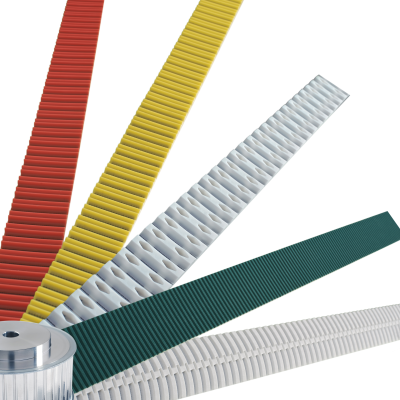
SYNCHROFLEX polyurethane timing belts in the power transmission unit of the CyBi-Well vario.

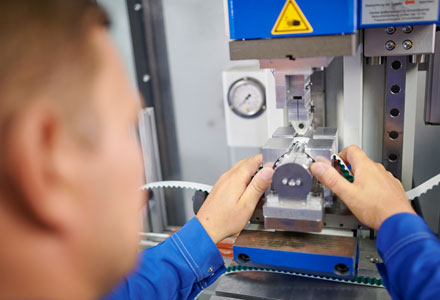
Martin Blossey (right) and André Schmidt conversing.
RoHS conforming range of pulleys
CyBio AG is also one of the first companies, which uses Mulco products in a tight RoHS string. All Mulco products have been available since the 1st of January, 2008 in conformity with RoHS. Synchronising pulleys, tension rollers and accessories, are free from lead, cadmium, mercury and hexavalent chromium, except for the boundary values permitted in the directive. In the plastics industry, this applies to flame retarding agents as well as to poly-brominated biphenyls (PBB) and poly-brominated diphenylether (PBDE). The highly wear resistant polyurethane used in timing belts from Mulco and the embedded steel cord tension members had been in conformity with RoHS from the very beginning.RoHS also led to changes in the cooperation between Mulco and the CyBio AG, says Martin Blossey. In the past, RoHS conforming material was either specified in the drawing, or high resistance AlZnMgCu0.5 (synchronising pulleys) was used despite the higher costs and time-related disadvantages. The RoHS conforming, lead-free aluminium (EN AW-AlCu4MgSi(A) / EN AW-2017A) now generally used by Mulco offers, in addition to its price advantage compared to special materials, the possibility to draw on all standard pulleys of the Mulco range held in stock, without having to depend on customised products and their respective delivery times.
Hanover, September 2008
www.mulco.net